

Access Thinking: a key term defined
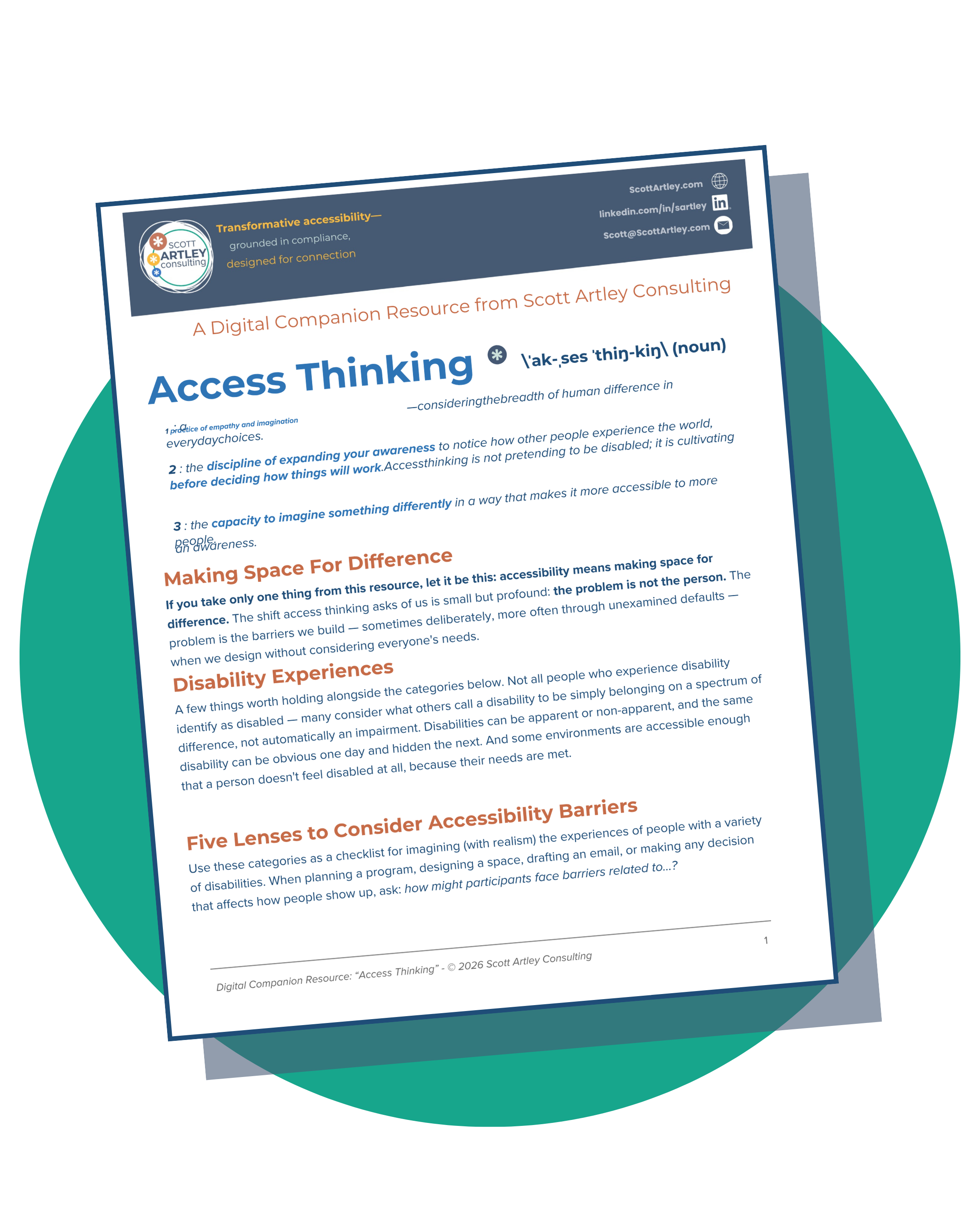
A digital companion resource created by Scott Artley
Scott Artley Consulting © 2026
Access Thinking \ˈak-ˌses ˈthiŋ-kiŋ\ (noun)
1 : a practice of empathy and imagination — considering the breadth of human difference in everyday choices.
2 : the discipline of expanding your awareness to notice how other people experience the world, before deciding how things will work. Access thinking is not pretending to be disabled; it is cultivating an awareness.
3 : the capacity to imagine something differently in a way that makes it more accessible to more people.
Making Space For Difference
If you take only one thing from this resource, let it be this: accessibility means making space for difference. The shift access thinking asks of us is small but profound: the problem is not the person. The problem is the barriers we build — sometimes deliberately, more often through unexamined defaults — when we design without considering everyone's needs.
Disability Experiences
A few things worth holding alongside the categories below. Not all people who experience disability identify as disabled — many consider what others call a disability to be simply belonging on a spectrum of difference, not automatically an impairment. Disabilities can be apparent or non-apparent, and the same disability can be obvious one day and hidden the next. And some environments are accessible enough that a person doesn't feel disabled at all, because their needs are met.
Five Lenses to Consider Accessibility Barriers
Use these categories as a checklist for imagining (with realism) the experiences of people with a variety of disabilities. When planning a program, designing a space, drafting an email, or making any decision that affects how people show up, ask: how might participants face barriers related to…?
S - SENSORY EXPERIENCE - How people sense the world.
Lighting, acoustics, fragrance, overstimulation, ways of seeing and hearing, the felt environment of a space.
M - MOBILITY - How bodies interact with physical space.
Transportation, entrances, pathways, restrooms, ramps and elevators, room to move, room to rest.
C - COMMUNICATION - How information is shared and received.
Preferred formats, plain language, alt text, signage, interpretation, captions, the multiple paths information needs to travel.
K - KNOWLEDGE - The information needed to participate.
What to expect, what is offered, how to ask for what you need, staff who know what to do when someone asks.
S - SOCIAL SYSTEMS - The cultural, economic, and structural conditions of participation.
Belonging, safety, cost, representation, scheduling, who is in the room and who is not, who decides who counts.
What does “S.M.C.K.S.” stand for?
Nothing. Literally nothing. It’s just a fun reference to how this tool was adapted by the “S.M.I.LE.” framework developed by Upstream Arts (upstreamarts.org), a Minneapolis-based organization that used the power of the creative arts to activate and amplify the voice and choice of individuals with disabilities. Although Upstream has recently sunsetted their operations, their influence keeps rippling outward.
Tangible And Structural
Barriers come in two forms, and access thinking holds both at once.
● Tangible barriers are the in-the-moment obstacles — the missing ramp, the absent interpreter, the form that won't accept your file format, the room with no chairs. These are usually what people mean when they say 'accessibility,' and they are real. They are also the easiest to see.
● Structural barriers are baked into policies, defaults, and assumptions — the leave policy that assumes a clear end to illness, the budget process that treats access as an add-on, the meeting culture that rewards quick verbal response, the funding application that times out before you can finish it.
Many of us with disabilities do not experience ableism mainly as a series of hostile acts. We experience it as a constant misfit with how things are set up. That is why access thinking means looking not just at what is missing in the room, but at how the room got built that way — and at who was, and was not, in mind when it was built.
Practicing in Community
Access thinking gets sharper with use, and it gets sharpest in conversation. A few invitations:
• Run the SMCKS questions out loud during your next planning meeting. The categories are designed to surface things one person alone tends to miss.
• When you find a barrier, ask whether it is tangible, structural, or both. The structural ones often explain why the tangible ones keep coming back.
• Treat naming a barrier as the first step, not a verdict. Identifying something that is not working is the practice — not a sign that you have failed.
Keep Going
Access is a collaborative journey, not a destination. Stay curious. A few ways to stay in motion:
Access Hour gatherings. A regular, free space to practice access thinking together in community. Bring a question, a problem you're stuck on, or just curiosity about what others are working on. Approximately every other month, check out upcoming dates and details at scottartley.com/Access-Hour.
Work together. I work with arts and cultural organizations on assessments, planning, speaking engagements, and capacity-building around accessibility and disability inclusion.
Access Thinking is a fundamental conceptual tool for broadening access for people with disabilities. It represents a rigorous but flexible practice considering the breadth of human difference in everyday choices. Scott Artley coined the term and has used it in his consulting work to help people systematically and empathetically review access barriers and imagine solutions.
The download button below opens the PDF for download in a new tab or window. It has been designed for accessibility and screen reader compatibility. Please reach out if another format would be a more effective option for you.